Saturday, 11 June 2011

A walk from Sowton village

Now that summer has arrived I have so many things to blog about, but with our wedding only a month away and the garden and house requiring a lot of attention there seems little time for blogging.

Last week we drove to the village of Sowton - just on the other side of the motorway from our house. Unfortunately an entire row of thatched cottages were destroyed in a fire there only last month.

This photo, taken from a distance, was the only one I took because some of the owners were there moving furniture out and I didn't want to be insensitive. You can't really see the scale of the destruction here, but it shocked us both. The whole area still smelled of burning.

Our walk from Sowton took us past Bishop's Court, home to 20 Bishops of Exeter over a 300 year period before it was sold in 1546. I'm not actually sure how old the house is:


The thatched gatehouse:

We saw our first ladybird larva of the year in a hedgerow:

A beautiful field of barley:

This Ephemera species of mayfly was near the river Clyst:

Monday, 23 May 2011

On the Way Home

On our way back from Hampshire we stopped in the New Forest to see the Rufus stone:


We got hungry near Dorchester and there being no services apart from a McDonalds we drove through the town-centre to look for a supermarket. The road passes very close to the Keep Military Museum:

Built from Portland stone in 1879 the Keep was designed to resemble a Norman Castle.

West Dean Gardens

Some other photos taken at West Dean:

I do love alliums and they look so at home amongst vegetables and herbs:

The thatched apple store in the wall surrounding the orchard is delightful:

The 300 foot long pergola is nearly one hundred years old:


During the winter 104 climbers are detached from the columns, pruned and retied - a massive job, but they do look beautiful


The view of West Dean College (formerly the house) from the arboretum:

Friday, 20 May 2011

West Dean Gardens - The Fruit Trees

The fruit trees at West Dean are shaped into some wonderful shapes.

Some grow up the walls in fans:

cordons:

or s-shapes (I don't know the proper name for these):

others near the walls include four-winged goblets:

and pyramids:

In the centre of the orchard the trees are left to grow naturally:

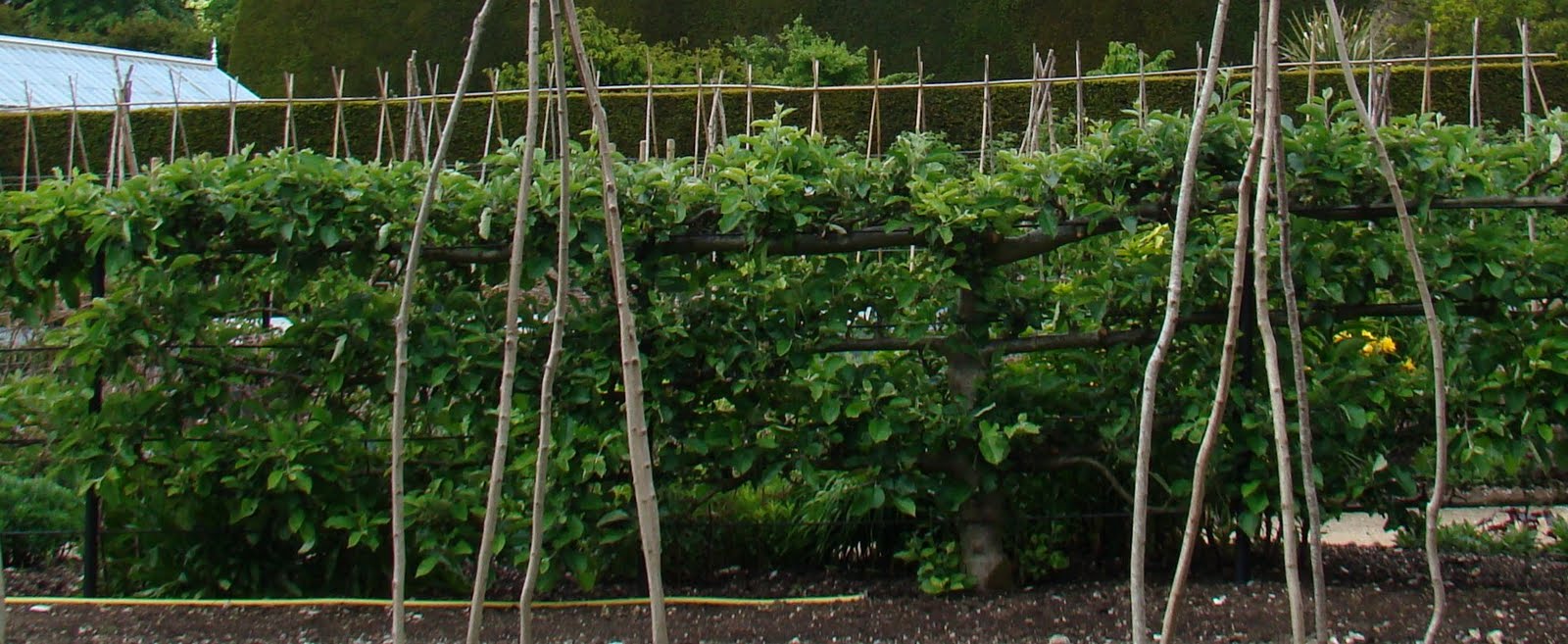
In the vegetable garden the borders are divided by fruit trees trained as espaliers:

or in arches:

Monday, 16 May 2011

West Dean Gardens - the floral display house

The floral display glasshouse had some beautiful orchids in flower:


This one prefers cooler conditions and was in the fern house:

West Dean Gardens - the Glasshouses

On my birthday we visited West Dean gardens in West Sussex - a place we fell in love with when we visited the area in 2008. In addition to being home to ordinary gardens, parkland and an arboretum, West Dean has the most magnificent walled garden. It's divided into a number of sections including an orchard containing hundreds of local varieties of fruit trees, vegetable and fruit gardens and 13 beautiful glasshouses, each divided into two to give 26 different growing environments. Each glasshouse houses something different, ranging from grape vines to fig trees to chilli plants to spectacular orchids. Since we visited on a weekday this time we had the glasshouses to ourselves.

Since I took so many photos this will be the first of a few posts on West Dean:

A peach growing on the wall of a glasshouse:

This is a single grape vine:

An approximately hundred year old fig tree:

The chilli house:

Even their labels are adorable:

Wednesday, 11 May 2011

Farlington Marshes

After dinner on Sunday we visited Farlington Marshes - a nature reserve on the edge of Langstone Harbour:

Actually we couldn't find it at first so we walked for quite a distance along the harbour wall to the East of the reserve before the heavens opened and soaked us. We dried off pretty quickly (apart from our shoes) while exploring the marshes:

We saw and heard lapwings, gulls, shelduck and other unidentifiable birds.

Many species seemed to favour the harbour wall, including a number of caterpillars, pale-coloured snails and plants:

I think this is sea kale:

but I'm not sure about this one:

We'd really like to return to the marshes when the geese are there. Every year around 26,000 brent geese (10% of the world total) visit the area. That must be an incredible sight.